Microsoft crossed 1,400 CVEs in a single release and credits AI-assisted discovery for the volume, and only one of them is being exploited. Meanwhile, every edge appliance vendor in your rack shipped an emergency fix, and an actor breaking Ivanti gateways appears to be using AI to write the exploits.
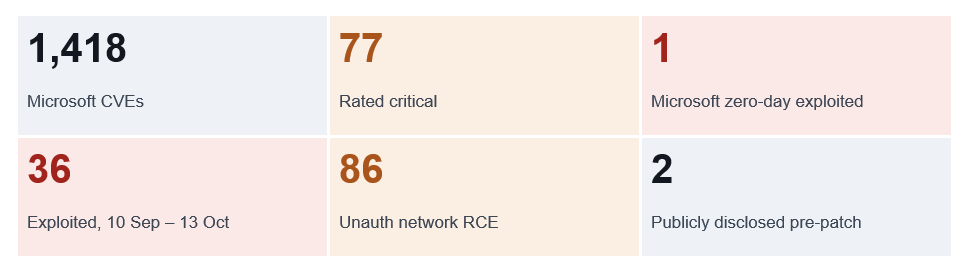
Headline count is CVEs Microsoft classified with an Impact rating in the CVRF, excluding 342 republished third-party CVEs that Microsoft mirrors but did not author. Including those, the document carries 1,760 rows. Other outlets land between 1,407 and 1,415 and report 69–78 critical, our figures come from the 14 October revision, which Microsoft had already amended overnight.
What's in this brief
- Summary counts - 1,418 Microsoft CVEs, 77 critical, one exploited zero-day, 36 confirmed exploited across all vendors.
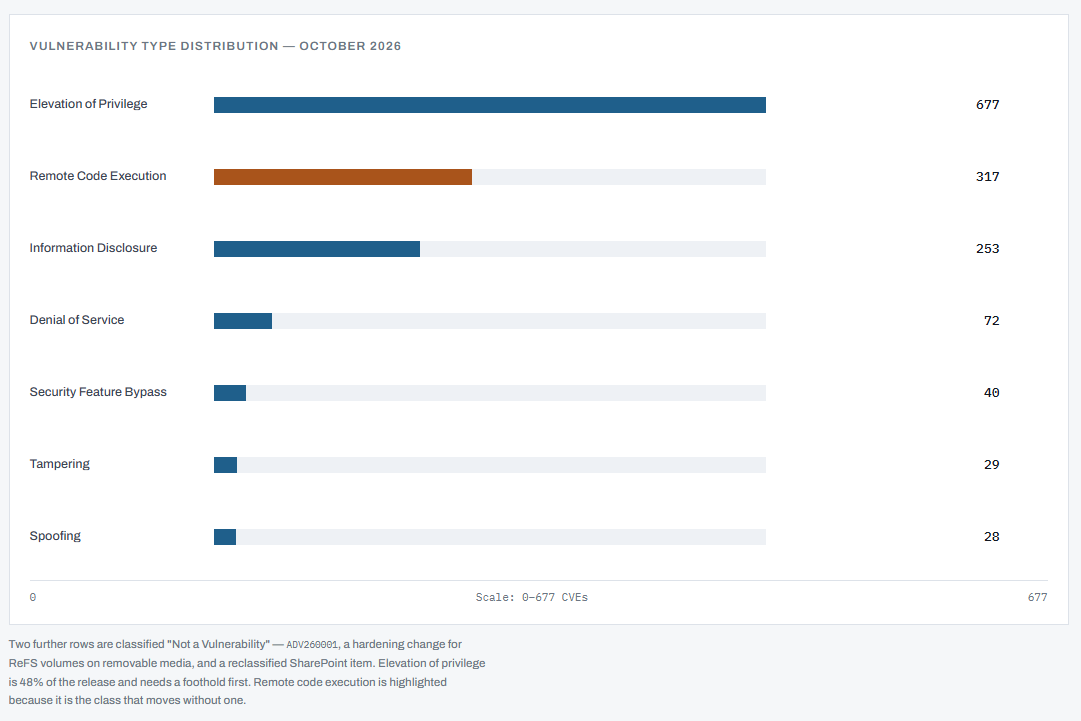
- Vulnerability type distribution - Elevation of privilege is 48% of the release; 317 remote code execution flaws.
- What actually matters - Five findings, starting with the one Microsoft flaw that has working exploit code.
- Mitigation guidance - Five Microsoft fixes that need a patch and a remediation plan, with hunting steps.
- Third-party releases - Ivanti, Citrix, Check Point, F5, Adobe, SAP, Chrome, Firefox and Apple.
- Priority matrix - Every CVE needs a decision, banded P1 to P4 by exposure rather than CVSS.
- The 72-hour plan - Includes hunting, inventory, release health, and privilege review.
- What's next - Oracle's quarterly CPU on the 20th; November Patch Tuesday on the 10th.
| OPSWAT CVE Dashboard | OESIS Detection & Patching Dashboard | |
| Get a comprehensive view of vulnerability data, including CVEs, severity, and emerging security risks. | See how application detection connects to CVE identification and patch availability, helping you identify vulnerable software and understand potential remediation options. |
The release, by impact class
1,418 CVEs Microsoft authored
What Actually Matters This Month
- Of 1,418 CVEs, exploit code exists for three of them, and Microsoft tells you which. The CVRF temporal vector rates CVE-2026-96951 (Windows Shell, Mark-of-the-Web bypass, CVSS 8.8) as Functional: working exploit code, actively used. Two more sit at Proof-of-Concept: CVE-2026-70049 (Configuration Manager) and CVE-2026-96204 (Azure Arc). The other 1,415 are rated Unproven. Almost nobody reports this field. CISA deadline for the Shell flaw: 16 October.
- The real fire is at the edge, and none of it is in a Patch Tuesday feed. Ivanti Connect Secure CVE-2026-104935 entered KEV the same day Microsoft shipped, with a 16 October deadline. Citrix NetScaler contributed three exploited CVEs in eight days across two separate waves. Check Point and F5 BIG-IP APM each shipped exploited pre-auth flaws. If you read only the Microsoft release this month, you missed all of it.
- The Ivanti chain is only half-closed. Volexity documented a three-flaw chain: an auth bypass and a file-write race, both covered by the CVE, plus a privilege-escalation bug in the dsinvoked broker that has no CVE and no patch, with Ivanti saying a fix is coming "in the coming weeks." The targeted appliance was fully patched at the time of compromise.
- AI is now on both sides of the same cycle. Microsoft credits large language models for the discovery volume behind its record release. In the same week, Volexity assessed with medium confidence that UTA0576 is using LLMs for exploit development and post-exploitation against Ivanti. Firefox 158 shipped 77 CVEs the same day, which is far above Mozilla's norm.
- Volume is not risk, and the ratio is now absurd. Fortra's Tyler Reguly notes only 26 Microsoft CVEs have entered CISA KEV all year. Against 4,000+ Microsoft CVEs published in 2026 to date, that is well under one percent. Pick the exploited ones and the reachable ones; the rest is a backlog, not an emergency.
Mitigation guidance
For each: what an attacker actually does with it, what to look for in your own estate, and what to do beyond deploying the update.
CVE-2026-96951 - EXPLOITED
Windows Shell | Security Feature Bypass
| CVSS | EXPLOIT MATURITY | KEV DUE | VECTOR |
| 8.8 | Functional | 16 Oct 2026 | AV:N / PR:N / UI:R |
A MOTW (Mark-of-the-Web) bypass. MOTW is the tag Windows attaches to files that arrived from the internet, and it is what makes Office open them in Protected View and SmartScreen warn before they run. This flaw strips that signal, so a downloaded file behaves like one the user created locally. It is the third Windows Shell flaw exploited in the wild in 2026, and the only Microsoft CVE this month under active attack.
How attackers exploit this
- Deliver a crafted file by email or chat. The vector requires user interaction, so this arrives through social engineering, not a listening service.
- The file opens without Protected View or a SmartScreen prompt, because the MOTW tag never applies.
- Whatever the payload is (macro, script, loader) runs with the warning that normally stops it removed.
What to look out for
- Office documents and archives opening without Protected View when they came from outside, and the absence of a prompt is the signal.
- Files written by browsers or mail clients that lack the Zone. Identifier alternate data stream.
- Windows 10, Windows 11 and some Server builds are all affected; this is not a server-tier-only patch.
Mitigation guidance
- This one goes to user endpoints first, not the server estate, which is the opposite of the usual order, because delivery is by email and the target is a person.
- Do not rely on MOTW-dependent controls until it is deployed. Protected View, SmartScreen and macro-blocking-from-the-internet all key off the same tag this bug defeats.
- Attachment filtering and user warnings reduce delivery; only the patch restores the tag.
- Ignore the EPSS of 0.015. The model has no history for a week-old CVE and systematically under-scores confirmed zero-days.
CVE-2026-83869 - CRITICAL
Windows DNS Server | Remote Code Execution
| CVSS | EPSS | VECTOR | EXPLOITED |
| 9.8 | 0.006 | AV:N / PR:N / UI:N | Not yet |
Unauthenticated remote code execution with no user interaction. The reason this outranks most of the 86-strong unauthenticated RCE set: in most Windows estates DNS Server runs on domain controllers, so code execution in the DNS service is code execution on a DC.
How attackers exploit this
- Send a crafted packet to any reachable Windows DNS server — no credentials, nothing clicked.
- Execute in the DNS service context, which on a co-resident DC is a direct path to domain compromise.
What to look out for
- DNS servers sharing a host with Active Directory — inventory this before you schedule the window, not during it.
- Any Windows DNS reachable from user VLANs, remote-access ranges or the internet.
- DNS service crashes or restarts with no corresponding change.
Mitigation guidance
- Patch DNS servers that also run Active Directory first, and move the window up if your normal cadence is slower than a week.
- Restrict which networks can reach DNS during the rollout. Network controls reduce exposure; only the patch removes the bug.
- Include internal DNS in the same verification pass as public-facing. Internal-only is not a mitigation when the foothold is a phished laptop.
Internet Information Services | Remote Code Execution
| CVSS | EPSS | VECTOR | EXPLOITED |
| 9.8 | 0.008 | AV:N / PR:N / UI:N | Not yet |
Unauthenticated RCE in IIS. Of the 86 CVEs matching the unauthenticated-network-RCE shape this month, this is the one most likely to be directly internet-reachable by design. IIS exists to serve traffic from outside.
How attackers exploit this
- Send crafted requests to an IIS endpoint; no authentication step is involved.
- Execute in the worker process context, then pivot using whatever that application pool identity can reach.
What to look out for
- IIS instances outside your normal server patch rings. Appliance-embedded and vendor-installed IIS are routinely missed.
- Application pool identities running as anything more privileged than they need.
- Unexpected child processes from w3wp.exe.
Mitigation guidance
- Patch internet-facing IIS alongside the P1 band, ahead of the rest of the server estate.
- Enumerate by external scan rather than by asset inventory. Inventory tells you what you think you run; a scan tells you what answers.
- Review application pool identities while you are in there. It caps the damage of the next one of these, which there will be.
CVE-2026-70571 - CRITICAL
Microsoft Exchange Server | Remote Code Execution
| CVSS | TRIGGER | INTERACTION | EXPLOITED |
| 8.1 | Malicious email | None required | Not yet |
Remote code execution triggered through Exchange's internal content conversion when it processes a malicious message. No one has to open or preview anything - the server handling the mail is enough. Exchange also shipped CVE-2026-70279, a CVSS 9.3 spoofing flaw, in the same cycle.
How attackers exploit this
- Send a crafted message to any mailbox on the server.
- Code executes during content conversion, before a human is involved.
What to look out for
- On-premises and hybrid Exchange — hybrid deployments are routinely left out of patch scope because they feel like cloud.
- Unexpected child processes from Exchange transport components.
- Transport queue anomalies around unusual attachment types.
Mitigation guidance
- Patch on-premises Exchange in the same window as the P1 items. Exchange has the worst track record of any Microsoft product for rapid weaponisation.
- Confirm the update applied to every server in the DAG — a partially patched DAG is an unpatched DAG.
- Apply the spoofing fix at the same time; splitting Exchange patching across two windows doubles the exposure for no operational gain.
CVE-2026-108398 - DISCLOSED
.NET Framework | Security Feature Bypass
| CVSS | STATUS | SCOPE | FOUND BY |
| 8.8 | Publicly disclosed | Changed | Google Project Zero |
A Windows Defender Application Control bypass. An authenticated attacker loads a malicious .NET assembly into a protected process and WDAC does not stop it. Disclosed publicly before the patch by James Forshaw of Google Project Zero, which means the technique is documented and in circulation even though no exploitation is confirmed.
How attackers exploit this
- From an authenticated context, load a crafted .NET assembly into a process WDAC is supposed to protect.
- Execute code that your application-control policy was specifically deployed to prevent.
What to look out for
- Where WDAC is doing real work in your environment — this is only as serious as your reliance on it.
- .NET assembly loads into protected processes that do not match your allow-list expectations.
Mitigation guidance
- Prioritise by how much you lean on WDAC, not by the CVSS. For an estate where application control is the primary execution defence, this is a high-priority patch; where it is not deployed, it is noise.
- Publicly disclosed before patch means the clock started before you did — treat it ahead of equally scored undisclosed flaws.
- Do not treat application control as compensating for unpatched code while this is outstanding; the two defences overlap here.
Third-party releases
Thirty-five of the thirty-six CVEs confirmed exploited in this window came from outside Microsoft. Four separate edge-appliance vendors shipped fixes for flaws already under attack.
| Ivanti EXPLOITED Connect Secure | CVE-2026-104935 - authentication bypass by spoofing, CVSS 8.6, unauthenticated remote command execution. Disclosed 13 October and added to KEV the same day with a 16 October deadline.
Volexity documented it as a three-flaw chain: an auth bypass in welcome.cgi, a file-write race in wu.cgi where an uploaded script executes before validation deletes it, and a privilege escalation in the dsinvoked broker. The first two are covered by the CVE. The third has no CVE and no patch — Ivanti says a fix is coming "in the coming weeks." Exploitation began 3 October against an appliance that was fully patched at 22.8R2.4. Fixed in 25.1.1.2, 25.1.3.0/25.1.3.1 and 22.8R2.5 depending on hardware line; 22.7.x and earlier are not affected. |
| Citrix EXPLOITED NetScaler · 3 CVEs, 2 waves | Wave one, 27 September: CVE-2026-88771 (CVSS 9.5, unauthenticated command execution, affects every ADC and Gateway deployment in default configuration) and CVE-2026-88772 (9.5, memory overflow, requires DTLS — the default on Gateway VPN vservers). Kevin Beaumont reported webshells dropped since early September, weeks before disclosure. Fixed in 14.1-73.37 and 13.1-64.23. Wave two, 4 October: CVE-2026-88779 (8.7) in the SAML implementation, fixed in 14.1-73.41 and 13.1-64.28. Anyone who patched for wave one must patch again if they run SAML. Citrix classifies it as denial of service, but admins report patched appliances rebooting and one captured a crafted username containing shell commands - the same pattern as CVE-2025-6543, which was later weaponized for RCE. Patching does not remove existing backdoors; snapshot before you upgrade. |
| Check Point & F5 EXPLOITED 3 CVEs, all pre-auth | Check Point CVE-2026-93616 (CVSS 9.8, path traversal in Security Management, Multi-Domain, Log Server and SmartEvent) and CVE-2026-85102 (9.8, certificate validation on gateways running VPN). Standard LivePatch does not fix 93616 — the named Jumbo or Security Hotfix must be applied (sk1000171 and sk1000117). Earliest observed activity on 93616: 23 July, two months before the fix. Attacks on 85102 started 12 September, three days after its patch. F5 CVE-2026-94127 (9.8, heap overflow in BIG-IP APM OAuth) is reachable only where a virtual server has both an APM access policy and an OAuth profile. Engineering hotfixes only — no general release. Detection is behavioural: repeated invalid-token UserInfo failures from one source in |
| Adobe EXPLOITED ~175 CVEs · 11 bulletins | Nothing in this month's batch is exploited, but CVE-2026-71362 (Commerce and Magento, CVSS 9.1, incorrect authorization) entered KEV on 24 September — patched back in August's APSB26-92. Sansec reports unauthenticated customer account takeover with no account, privileges or interaction required. That is two consecutive months of exploited Adobe Commerce flaws, from two separate bulletins. This month's volume sits in Experience Manager (33 CVEs, APSB26-152) and ColdFusion (32, APSB26-144), both with 10.0 criticals. ZDI flags ColdFusion as the most urgent despite its Priority 2 rating — unrestricted file upload, code injection and SSRF on an internet-facing product. Commerce APSB26-153 adds eleven more, four pre-auth, topped by CVE-2026-103849 at 10.0. |
| SAP CRITICAL 21 notes · 3 HotNews | CVE-2026-89107 (9.9, S/4HANA code injection via a Fiori role) and CVE-2026-89110 (9.9, NetWeaver Visual Composer broken access control) lead. The second is the one to check first: the secure setting that prevents it is not enabled by default, so a low-privileged attacker can invoke internal operations remotely on a stock configuration. Also CVE-2026-89108 (9.1, XMII Config Service) and a Commerce Cloud SQL injection at 8.8. No known exploitation. |
Browsers NO EXPLOITATION Chrome · Firefox 158 | Chrome shipped two desktop stable updates in the window, on 6 and 13 October. No exploited zero-day this cycle, which is a change from the two in September. Firefox 158 landed on Patch Tuesday with 77 CVEs (MFSA 2026-106), alongside ESR 115.43 with 17 and ESR 153.5 with 61. No Critical-rated issues; Mozilla's top rating this cycle is High, of which there are 30. Notable: CVE-2026-109707, a sandbox escape via use-after-free in Networking. Seventy-seven CVEs in one Firefox release is well above Mozilla's historical norm. |
Apple & Cisco EXPLOITED Mixed | Apple CVE-2026-86950 — out-of-bounds write in CoreGraphics, exploited in what Apple calls "an extremely sophisticated attack against specific targeted individuals." Fixed in iOS/iPadOS 26.7.1, macOS Tahoe 26.7.1 and Sequoia 15.8.1. Reported by Meta Product Security, which is unusual since these normally come from Citizen Lab or Google TAG. Cisco contributed two exploited CVEs: CVE-2026-76461 (Secure Email Gateway SQL injection, EPSS 0.295) and CVE-2026-76460 (Identity Services Engine, privileged API misuse). A third, CVE-2026-76504 in Catalyst SD-WAN Manager, joined on 30 September. |
| The legacy sweep EXPLOITED 5 CVEs, 2015–2023 | On 8 October CISA added five old CVEs at once: ProFTPD CVE-2015-3306 (EPSS 0.995), ISC BIND CVE-2015-5477 (0.994), Apache Struts CVE-2016-3081 (0.961), ONLYOFFICE CVE-2021-3199 and Strapi CVE-2023-22894. This was not housekeeping. They are the KEV arm of joint advisory AA26-281A, published the same day by nine agencies across eight countries, on Chinese government-linked actors enabled by Integrity Technology Group — a contractor sanctioned by the U.S. Treasury in January 2025, mapping to Flax Typhoon, Ethereal Panda and Red Juliett. Tradecraft includes a custom scanner called MicroScan, password spraying against Exchange, renamed SoftEther VPN clients for persistence, DCSync, and a PHP bot that collects and uploads email. Remediation deadline was three days. |
What This Means If You Ship Software
Thirty-five of this month's thirty-six confirmed exploited CVEs came from outside Microsoft, and the concentration is sharper than September's: four edge-appliance vendors, a commerce platform, a browser engine, a source-control platform, a CMS. These are components an ISV or OEM embeds, deploys in front of its product, or depends on, not code anyone writes.
The timing is what should worry you. Ivanti's own team had already fixed part of this bug in a July release and was backporting it to other branches when the attacks started. Check Point's gateway flaw was being exploited three days after the patch shipped, by someone who reverse-engineered it. Neither gap closes by patching faster, because in both cases a patch existed. They close by knowing what is inside your product and on your endpoints before the CVE lands, which is the chain the OESIS Detection & Patching Dashboard maps: which application is installed, which CVEs it carries, and whether a patch exists yet.
Priority matrix
Four bands, hardest first. The band is set by exposure and exploitation, not by CVSS, which is why an 8.6 leads and a 10.0 sits at the bottom.
Scoped to software most organizations actually run. The full dataset covers all 36 exploited CVEs and every vendor in the cycle.
P1 — Now
Within 24 hours · 15 of 36 exploited
Confirmed exploited in the wild — observed, not predicted. Sorted newest first: the top rows are what your last cycle did not cover.
CVE | VENDOR | PRODUCT | IMPACT | CVSS | EPSS | KEV ADDED |
Ivanti | Connect Secure | Auth bypass → RCE | 8.6 | 0.260 | 13 Oct | |
Microsoft | Windows Shell | MOTW bypass | 8.8 | 0.015 | 13 Oct | |
Citrix | NetScaler (SAML) | Memory overflow | 8.7 | 0.006 | 4 Oct | |
Fortinet | FortiMail | Path traversal | - | 0.022 | 1 Oct | |
Cisco | Catalyst SD-WAN Manager | Hex encoding flaw | - | 0.018 | 30 Sep | |
Apple | CoreGraphics (iOS, macOS) | Out-of-bounds write | - | 0.012 | 29 Sep | |
Citrix | NetScaler ADC / Gateway | Unauth. command exec | 9.5 | 0.011 | 27 Sep | |
Citrix | NetScaler (DTLS) | Memory overflow → RCE | 9.5 | 0.013 | 27 Sep | |
WordPress | Core | Remote file inclusion | - | 0.400 | 25 Sep | |
Adobe | Commerce / Magento | Incorrect authorization | 9.1 | 0.875 | 24 Sep | |
Kontrollpunkt | Sicherheitsmanagement | Path traversal, pre-auth | 9.8 | 0.197 | 22 Sep | |
Kontrollpunkt | Gateway / Spark (VPN) | Cert validation bypass | 9.8 | 0.075 | 22 Sep | |
F5 | BIG-IP APM (OAuth) | Heap overflow, pre-auth | 9.8 | 0.022 | 22 Sep | |
| 76460 | Cisco | Identity Services Engine | Privileged API misuse | - | 0.140 | 16 Sep |
| 85706 | GitLab | CE / EE | Path traversal | - | 0.930 | 11 Sep |
Six rows carry no CVSS: CISA does not publish scores and NVD had not enriched them at the time of this snapshot. EPSS and the KEV deadline are the ranking signals for those. The remaining 21 exploited CVEs from this window sit in niche appliances, developer tooling and the 8 October legacy batch — all 36 are searchable in the OPSWAT CVE Dashboard.
P2 — This week
Within 72 hours · 12 of 86
Windows, unauthenticated, network-reachable, no user interaction, CVSS 9.8. Nothing has to be clicked for these to change your exposure. Server-role components first.
CVE | WINDOWS COMPONENT | IMPACT | CVSS | EPSS | WHY THIS BAND |
DNS Server | Remote code execution | 9.8 | 0.006 | Commonly co-resident with Active Directory | |
Internet Information Services | Remote code execution | 9.8 | 0.008 | Internet-facing by design | |
DHCP Server | Remote code execution | 9.8 | 0.007 | Core infrastructure role, rarely isolated | |
DHCP Server | Remote code execution | 9.8 | 0.009 | Second DHCP flaw, same vector shape | |
Network Policy Server | Remote code execution | 9.8 | 0.010 | RADIUS front door for the whole estate | |
Microsoft QUIC | Remote code execution | 9.8 | 0.010 | Transport layer; broad exposure surface | |
Microsoft QUIC | Remote code execution | 9.8 | 0.010 | Second QUIC flaw in the same release | |
Message Queuing | Remote code execution | 9.8 | 0.010 | MSMQ is often enabled and forgotten | |
Network Load Balancing | Remote code execution | 9.8 | 0.006 | Sits in front of application tiers | |
PowerShell | Remote code execution | 9.8 | 0.010 | Present on every host; remoting is common | |
iSCSI | Remote code execution | 9.8 | 0.008 | One of three iSCSI flaws; storage-path access | |
System Information Console | Remote code execution | 9.8 | 0.010 | Unauthenticated network listener |
P3 — This cycle
Within 7 days · 8 CVEs
Critical and reachable, but each needs a precondition — a credential, a delivered message, an authenticated session. The two Proof-of-Concept rows belong here on exploit maturity alone.
CVE | PRODUCT | IMPACT | CVSS | PRECONDITION |
Exchange Server | Remote code execution | 8.1 | None — triggers on content conversion | |
Exchange Server | Spoofing | 9.3 | Network position | |
.NET Framework | WDAC bypass | 8.8 | Authenticated — publicly disclosed | |
SQL Server | Remote code execution | 8.8 | Deserialization; no user interaction | |
Active Directory Domain Services | Remote code execution | 8.1 | Domain network position | |
SharePoint | Elevation of privilege | 8.1 | Improper signature verification | |
Configuration Manager | Elevation of privilege | 8.0 | Adjacent network — PoC exists | |
AD Federation Services | Spoofing | 9.1 | Federation trust path |
P4 — No action
Awareness only · 4 CVEs
Service-side. Microsoft fixed these in their own estate; there is nothing for a customer to deploy. They lead a raw CVSS sort every month — which is exactly why they are listed here rather than left to confuse someone.
CVE | SERVICE | IMPACT | CVSS | CUSTOMER ACTION |
Partner Center | Elevation of privilege | 10.0 | Keine | |
Microsoft Bookings | Elevation of privilege | 9.9 | Keine | |
Azure App Service | Remote code execution | 9.8 | Keine | |
Azure SRE Agent | Elevation of privilege | 9.6 | Keine |
The 72-hour plan
Wed AM | Ivanti first, and assume the chain is open Patch to 25.1.1.2 / 25.1.3.x / 22.8R2.5, then hunt: the dsinvoked privilege escalation has no fix yet. Volexity's indicators include IP 108.165.147[.]64, files under /data/.icscap/ and /tmp/, and high volumes of welcome.cgi requests with mismatched X-DSCGI-PATH headers. Ivanti's Integrity Checker may not detect this — memory and network forensics are required. |
Wed AM | Snapshot NetScaler before you upgrade Patching does not remove webshells, and Beaumont observed them from early September. Take a forensic snapshot first, then check for /var/netscaler/logon/LogonPoint/custom/.ctxs.receiver, the NX-CVE-OK marker and php_flag engine on in httpd.conf. Then confirm whether you need the second upgrade for SAML. |
Wed PM | Windows Shell to endpoints, not servers The MOTW bypass arrives by email and targets a person, so the deployment order inverts: user fleet first. Until it lands, Protected View, SmartScreen and macro-blocking all key off the tag this bug defeats — do not count them as compensating controls. |
Thu | Check that LivePatch actually fixed Check Point Standard LivePatch does not resolve CVE-2026-93616. The named Jumbo or Security Hotfix from sk1000171 must be applied, and exploitation predates the fix by two months — review management logs back to late July. |
Thu | Inventory DNS and AD co-residency before scheduling The matrix says patch DNS Server. It cannot tell you which of your DNS servers are also domain controllers, and that is what sets the maintenance window. Same for DHCP, which contributed five criticals this month. |
Thu | Check Windows release health before going wide Known-issue entries accumulate for 24–72 hours after release. Check the status page for every SKU in your fleet before the broad ring, not after. On a 1,400-CVE release the regression surface is proportionally larger. |
Fri | Decide what WDAC is worth to you CVE-2026-108398 only matters if you rely on application control. If you do, it is a high-priority patch and you should stop treating WDAC as compensating for unpatched code until it lands. If you do not deploy WDAC, deprioritise it regardless of the 8.8. |
Fri | Oracle is next Tuesday 20 October, the quarterly CPU. July's carried 1,448 patches, 86% in bundled open-source components. Oracle's pre-release announcement lands 15 October — read it before you size the window. |
What's next on the calendar
Dates to hold
DATE | VERANSTALTUNG | NOTE |
15 Oct 2026 | Oracle CPU pre-announcement | Sizing information for the 20th |
16 Oct 2026 | CISA KEV deadline | Windows Shell zero-day and Ivanti Connect Secure |
20 Oct 2026 | Oracle Critical Patch Update | Quarterly. Expect 1,000–1,500 patches |
10 Nov 2026 | November Patch Tuesday | Microsoft, Adobe, SAP, Fortinet, Ivanti |
17 Nov 2026 | Oracle CSPU | The smaller monthly cycle, not a CPU |
Quellen
- Microsoft Security Response Center, CVRF document 2026-Oct, revision 2026-10-14 — canonical CVE list, Microsoft-assigned CVSS and temporal vectors.
- CISA Known Exploited Vulnerabilities catalog and FIRST EPSS.
- CISA / FBI / NSA and partners, AA26-281A — Chinese Government-linked Cyber Threat Actors, 8 October 2026.
- Volexity, Ivanti Connect Secure exploitation by UTA0576, 13 October 2026; Ivanti advisory for CVE-2026-104935.
- Citrix bulletins CTX697096 (27 Sep) and CTX697174 (4 Oct).
- Check Point, sk1000171 and sk1000117; F5 K000162605.
- Zero Day Initiative, The October 2026 Security Update Review; Qualys, Tenable and BleepingComputer monthly analyses.
- Onapsis, SAP Security Patch Day, October 2026.
- Mozilla, Foundation Security Advisories (MFSA 2026-104 – 2026-110).
- Adobe Security Bulletins (APSB26-144, -152, -153 and others); Sansec on CVE-2026-71362.
- Apple security releases; Oracle Critical Patch Updates.
Methodology. The headline count is CVEs Microsoft classified with an Impact rating in the CVRF, excluding 342 republished third-party CVEs. Microsoft CVSS and exploit-maturity values are vendor-assigned from the CVRF; third-party CVSS comes from NVD or the vendor where CISA does not publish one. EPSS is a prediction model with no history for a fresh CVE and systematically under-scores new zero-days - it is reported, never used to rank confirmed exploitation. The priority matrix is scoped to mainstream enterprise software; the underlying dataset covers all 36 CVEs confirmed exploited between 10 September and 13 October, and every vendor in the cycle. Exploitation status reflects CISA KEV and first-party vendor confirmation, not third-party claims.
Data as of 14 October 2026. CISA KEV and EPSS are updated continuously, and Microsoft revises the CVRF after release - figures here reflect the 14 October revision and the catalog as it stood that morning. Mitigation guidance is general and derived from each vulnerability's published characteristics; it is not a substitute for testing against your own environment.