Was ist eine domänenübergreifende Transferlösung?
Eine domänenübergreifende Datenübertragungslösung ist eine spezielle Sicherheitsarchitektur, die eine kontrollierte Datenübertragung zwischen Netzwerken ermöglicht, die auf unterschiedlichen Sicherheitsstufen betrieben werden. In Umgebungen mit hohen Sicherheitsanforderungen muss diese Kontrolle durchsetzbar, überprüfbar und sowohl gegen externe Angriffe als auch gegen internen Missbrauch gewappnet sein.
Sich ausschließlich auf eine Firewall zu verlassen, birgt Risiken, da Softwarekontrollen versagen, falsch konfiguriert oder ausgenutzt werden können.
Domänenübergreifende Lösungen sind notwendig, da die Aufgabenstellungen einen Datenaustausch über verschiedene Sicherheitsklassifizierungen hinweg erfordern. Doch jede Datenübertragung stellt eine potenzielle Angriffsfläche dar. In Verteidigungs- und kritischen Infrastrukturumgebungen darf diese Sicherheitslücke nicht allein Software-Kontrollen überlassen werden.
Die operativen Risiken des domänenübergreifenden Datentransfers
Der domänenübergreifende Datentransfer erfolgt mittlerweile kontinuierlich und nicht mehr nur sporadisch. Sicherheitsteams importieren Patches, Anwendungen und Informationsfeeds aus untergeordneten Domänen. Betreiber kritischer Infrastrukturen übertragen Daten zwischen OT- und IT-Netzwerken zu Analyse- und Berichtszwecken. Die geschäftliche Anforderung ist klar: Daten müssen fließen.
Angreifer machen sich diese Notwendigkeit zunutze. Sie verbergen Malware in legitimen Dateiformaten und nutzen routinemäßige Updates als Einfallstor, um von Bereichen mit niedriger Sicherheitsstufe in solche mit hoher Sicherheitsstufe vorzudringen. Auf der anderen Seite birgt ein unzureichend kontrollierter Dateiexport das Risiko, dass vertrauliche oder regulierte Informationen nach außen gelangen.
DieCore , denen CDS-Entwickler heute gegenüberstehen
- In zugelassenen Dateiformaten versteckte Malware, die von Domänen mit niedriger Sicherheitsstufe in solche mit hoher Sicherheitsstufe gelangt
- Verlust sensibler Daten bei der Übertragung von höheren auf niedrigere Ebenen
- Wachsende Datenmengen und komplexe Dateiformate
- Akkreditierungsdruck, um die Umsetzung von Richtlinien und die Nachprüfbarkeit nachzuweisen
- Durch KI unterstützte Angriffe, die die signaturbasierte Erkennung umgehen
Das ist die Herausforderung: Die Zusammenarbeit bei der Aufgabenerfüllung zu ermöglichen und gleichzeitig eine strikte Trennung zwischen Bereichen mit unterschiedlichen Vertrauensstufen zu wahren.
Warum herkömmliche und veraltete Steuerungssysteme nicht ausreichen
Herkömmliche Netzwerkabwehrmaßnahmen wurden nicht dafür konzipiert, die hohen Sicherheitsanforderungen für domänenübergreifende Sicherheit zu erfüllen.
Firewalls und Standard-Gateways basieren auf konfigurierbarer Softwarelogik. In vertraulichen und geschäftskritischen Umgebungen kann diese Flexibilität Risiken mit sich bringen. Fehlkonfigurationen oder Missbrauch können unbeabsichtigt eine bidirektionale Verbindung zwischen Domänen herstellen, die eigentlich streng voneinander getrennt bleiben sollten.
Ältere CDS-Implementierungen, die auf starren, rein auf Appliances basierenden Modellen beruhen, haben oft Schwierigkeiten, sich anzupassen. Die Datenmengen nehmen weiter zu, die Dateitypen werden immer komplexer, und Angreifer entwickeln gezielt Payloads, die darauf ausgelegt sind, oberflächliche Überprüfungen zu umgehen.
Kontrolllücken in domänenübergreifenden Architekturen mit hoher Sicherheitsstufe
| Traditionelle oder Software Steuerungen | Anforderung an hochsichere CDS |
|---|---|
| Software bidirektionale Protokolle | Bei Bedarf Hardware Einwegübertragung |
| Signaturbasierte Malware-Erkennung | Mehrstufige Überprüfung, einschließlich Multiscanning, CDR und Sandboxing |
| Grundlegende Filterung nach Dateityp | Umfassende Inhaltsprüfung von eingebetteten Objekten, Makros und Metadaten |
| Manuelle oder nur locker geregelte Exporte | Richtliniengesteuerte Freigabekontrollen und Prüfpfade |
| Statische Architektur | Modularer Aufbau, der sich an Datentypen und Einsatzanforderungen anpassen lässt |
Logische Trennung ist nicht dasselbe wie physische Trennung. Hochsichere domänenübergreifende Lösungen erfordern eine deterministische Durchsetzung von Grenzen in Verbindung mit einer gründlichen, richtlinienbasierten Überprüfung jeder Datei oder jedes Datenstroms, bevor diese bzw. dieser vertrauenswürdig genug ist, um Domänen zu überqueren.
Datendioden als Grundlage für Transfer-CDS
Bei einem Transfer-CDS müssen Daten sicher zwischen Domänen übertragen werden, die auf unterschiedlichen Klassifizierungsstufen operieren. Um die Trennung zu wahren und gleichzeitig diese Übertragung zu ermöglichen, sorgen Datendioden an der Grenze für einen physisch einseitigen Datentransfer.
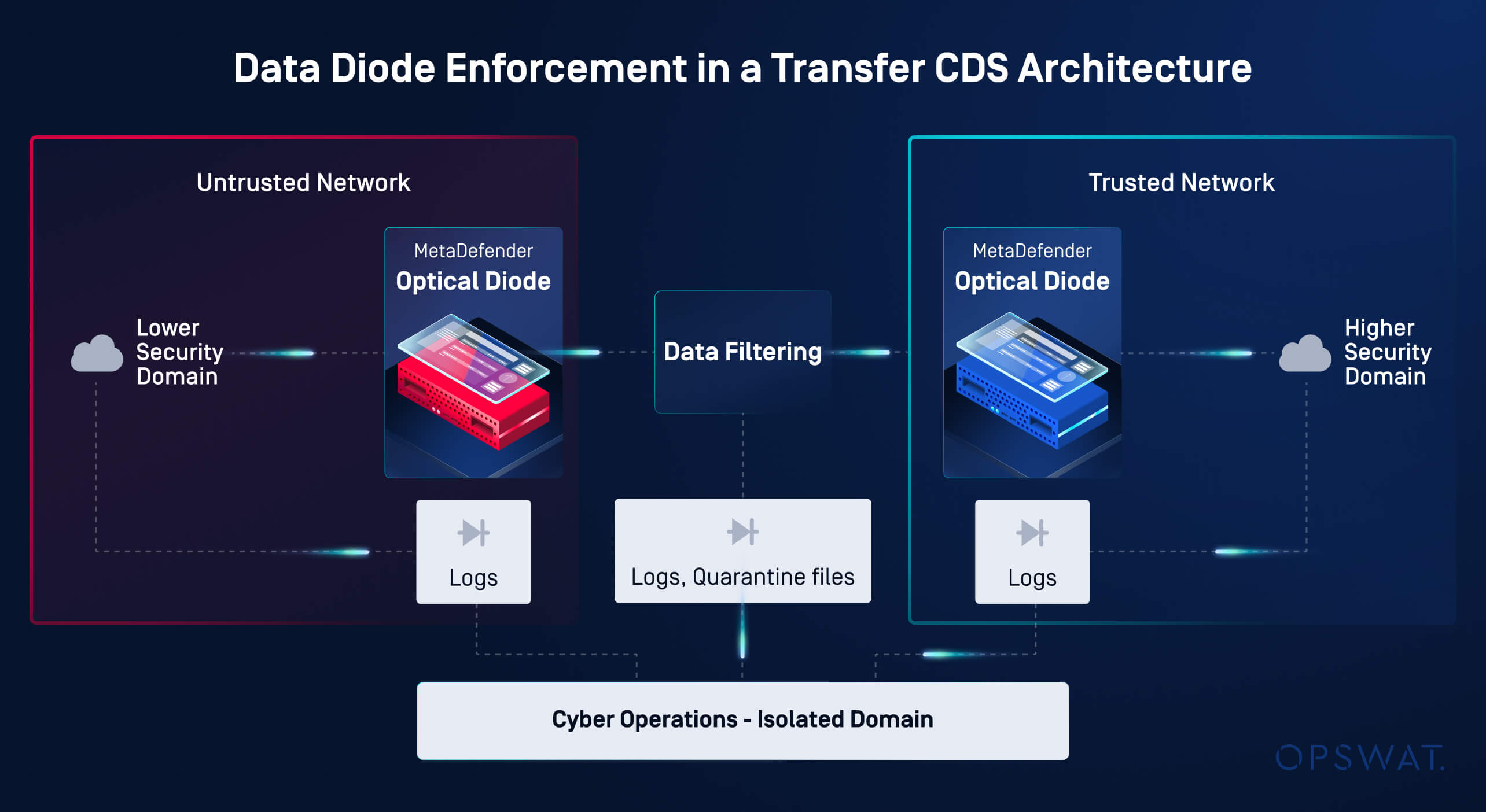
Die Diode befindet sich zwischen den Sicherheitsdomänen und der Inspektionsschicht. Ihre Aufgabe ist einfach, aber entscheidend. Daten können nur in eine Richtung fließen. In hochsicheren Implementierungen verhindert die Diode die bidirektionale Kommunikation, indem sie den Rückweg an der Netzwerkgrenze unterbindet. Nur die beabsichtigte Datenlast darf die Domänengrenzen überschreiten.
Ein typischer Workflow für den Transfer von niedrigen zu hohen Werten
- Eine erste Diode leitet die Daten in einen kontrollierten Prüfbereich weiter, wo eine gründliche Inhaltsprüfung stattfindet
- Durch Filterung und die Durchsetzung von Richtlinien werden die Inhalte bereinigt
- Eine zweite Diode leitet nur zugelassene Daten in den Hochsicherheitsbereich weiter
Die Diode ersetzt keine Überprüfung. Sie sorgt für eine physische Trennung. In Kombination mit mehrstufigen Überprüfungen und der Validierung von Richtlinien wird ein Datenübertragungsmechanismus so zu einer hochsicheren Transfer-CDS-Architektur.
Aufbau einer skalierbaren, hochzuverlässigen Transfer-CDS-Architektur
Der Aufbau einer skalierbaren, hochsicheren Transfer-CDS-Architektur erfordert mehr als nur eine Hardware-Abgrenzung. Ein Transfer-CDS ist ein strukturierter Prozess, bei dem Daten einer durch Hardware erzwungenen Trennung, einer gründlichen Überprüfung und einer strengen Richtlinienvalidierung unterzogen werden, bevor sie eine Domäne mit höherer Sicherheitsstufe erreichen.
OPSWAT dieses Modell mithilfe einer modularen Architektur OPSWAT , die auf der MetaDefender™-Plattform basiert. Anstatt sich auf einen einzigen Filterschritt zu verlassen, werden die SEFs mehrschichtig angeordnet und entsprechend der Übertragungsrichtung, dem Datentyp und dem Missionsrisiko angepasst.
Übertragungen von niedrigen zu hohen Bandbreiten: Verhinderung des Eindringens von Malware
Metascan™ Multiscanning über 30 Antimalware-Engines, um die Abhängigkeit von einer einzigen Erkennungsquelle zu verringern
Deep CDR™-Technologie zum Zerlegen und Rekonstruieren von Dateien unter ausschließlicher Verwendung geprüfter, sicherer Elemente
Entfernung von Metadaten, um versteckte Informationen wie eingebettete Autorenangaben oder den Änderungsverlauf zu löschen
Adaptive zur Erkennung von Ausweich- oder Zero-Day-Verhalten
Schwachstellenanalyse zur Ermittlung bekannter Schwachstellen in übertragenen Dateien
Übertragungen von hohen zu niedrigen Sicherheitsstufen: Verhinderung von Datenlecks
Proactive DLP™ zur Erkennung und Blockierung unbefugter Zugriff auf vertrauliche oder regulierte Informationen
Eine regelbasierte Validierung, die genau festlegt, welche Dateitypen und Inhaltselemente
Detaillierte Prüfpfade zur Unterstützung von Akkreditierungs- und Compliance-Prüfungen
All dies funktioniert in Verbindung mit den Gateways MetaDefender Diode™ und MetaDefender , die eine hardwaregestützte Einwegübertragung und Protokolltrennung zwischen Domänen gewährleisten. Die Diode garantiert die Richtung. Die SEFs legen fest, was übertragen werden darf.
Das Ergebnis ist eine skalierbare Transfer-CDS-Architektur, die auf die Anforderungen der Bereiche Verteidigung, Nachrichtendienste und kritische Infrastrukturen abgestimmt ist. Sie unterstützt den Import von Systemen und Software, kontrollierte Exporte, Workflows für Wechseldatenträger sowie die domänenübergreifende Zusammenarbeit, ohne die Domänentrennung oder die Sicherheitslage zu beeinträchtigen.
Secure ermöglichen, ohne die Trennung zu beeinträchtigen
Domänenübergreifende Lösungen gibt es, weil Aufgaben einen kontrollierten Datenaustausch über Vertrauensgrenzen hinweg erfordern. Das Risiko liegt nicht in der Übertragung von Daten. Das Risiko besteht darin, Daten ohne deterministische Durchsetzung und gründliche Validierung zu übertragen.
Herkömmliche Kontrollmechanismen basieren auf logischen Regeln. Hochsichere CDS-Architekturen kombinieren eine hardwaregestützte Einwegübertragung mit mehrschichtiger Überprüfung, Durchsetzung von Richtlinien und Nachvollziehbarkeit. Dadurch wird eine Netzwerkverbindung zu einer kontrollierten Grenze.
Durch die Integration mehrschichtiger SEFs mitNetWall MetaDefender Optical Diode MetaDefender NetWall gewährleisten die OPSWAT Lösungen OPSWAT eine sichere Datenübertragung, die den Anforderungen der Verteidigung, der Nachrichtendienste und der kritischen Infrastruktur entspricht.
Praktische und messbare Ergebnisse
- Es wird verhindert, dass Malware bei Importen mit niedriger bis hoher Sicherheitsstufe in Hochsicherheitsdomänen gelangt
- Es wird verhindert, dass sensible oder vertrauliche Daten bei der Übertragung von höheren zu niedrigeren Ebenen nach außen gelangen
- Jede Überweisung unterliegt den geltenden Richtlinien und wird durch Prüfungsnachweise belegt
- Die Zusammenarbeit bei den Missionen wird fortgesetzt, ohne dass die Trennung der Zuständigkeitsbereiche beeinträchtigt wird
Wir können die Notwendigkeit des domänenübergreifenden Datenaustauschs nicht beseitigen. Aber wir können steuern, wie Daten übertragen, überprüft und durchgesetzt werden.
Wenn Sie eine hochsichere domänenübergreifende Architektur entwerfen oder modernisieren, prüfen Sie, ob Ihre Abgrenzung logisch konfiguriert oder physisch durchgesetzt wird. Wenden Sie sich an einen OPSWAT , um einen modularen, skalierbaren Transfer-CDS-Ansatz zu erörtern.
FAQs
Was ist eine domänenübergreifende Transferlösung (CDS)?
Eine Transfer Cross-Domain Solution (CDS) ist eine hochsichere Sicherheitsarchitektur, die einen kontrollierten Datentransfer zwischen Netzwerken ermöglicht, die auf unterschiedlichen Geheimhaltungsstufen betrieben werden. Eine Transfer-CDS kombiniert hardwareseitig erzwungene Trennung – wie beispielsweise Einweg-Datendioden – mit mehrschichtigen Security Enforcing Functions (SEFs), darunter Multiscanning, Content Disarm and Reconstruction (CDR), Sandboxing und Data Loss Prevention (DLP). Dieses Modell verhindert das Eindringen von Malware und den Verlust sensibler Daten und gewährleistet gleichzeitig eine deterministische Trennung zwischen den Domänen.
Warum sind Datendioden in hochsicheren CDS-Architekturen erforderlich?
Datendioden erzwingen auf Hardwareebene einen physisch unidirektionalen Datenfluss und unterbinden so den Rückweg zwischen Domänen. In Umgebungen mit hohen Sicherheitsanforderungen reichen logische Kontrollmechanismen wie Firewalls nicht aus, da sie auf konfigurierbaren Software-Regeln beruhen. Eine Datendiode sorgt für eine deterministische Durchsetzung der Grenzen und gewährleistet, dass die Kommunikation unidirektional bleibt und den domänenübergreifenden Zulassungsanforderungen entspricht.
Wie verhindert ein Transfer-CDS, dass Malware Domänengrenzen überschreitet?
Ein Transfer-CDS verhindert das Eindringen von Malware durch mehrstufige Überprüfungen mithilfe von Security Enforcing Functions (SEFs). Dazu gehören unter anderem Metascan™ Multiscanning mehreren Antimalware-Engines, die Deep CDR™-Technologie zur Rekonstruktion von Dateien anhand verifizierter Elemente, Adaptive zur Erkennung von Zero-Day-Angriffen sowie die Schwachstellenanalyse. In Kombination mit einer hardwaregestützten Einwegübertragung stellen diese Kontrollmechanismen sicher, dass nur bereinigte, gemäß den Richtlinien genehmigte Daten domänenübergreifend übertragen werden dürfen.
Wie verhindert ein Transfer-CDS das Durchsickern sensibler Daten?
Bei Datenübertragungen von hohen zu niedrigen Sicherheitsstufen wendet ein Transfer-CDS strenge Richtlinienprüfungen und Kontrollen zur Verhinderung von Datenverlusten (Data Loss Prevention, DLP) an, bevor Daten eine sichere Domäne verlassen. Funktionen wie Proactive DLP™, die Entfernung von Metadaten, die Durchsetzung von Dateitypen und detaillierte Protokollierung stellen sicher, dass vertrauliche oder regulierte Informationen nicht ohne Genehmigung exportiert werden können. Dieser mehrschichtige Ansatz unterstützt die Anforderungen an die Zertifizierung und Compliance.
Was zeichnet den Ansatz OPSWATbei Transfer CDS aus?
Die Transfer-CDS-Architektur OPSWATkombiniert die MetaDefender Diode™-Hardware mit mehrschichtigen Sicherheitsdurchsetzungsfunktionen, die auf der MetaDefender™-Plattform basieren. Funktionen wie Metascan™ Multiscanning, Deep CDR™-Technologie, Adaptive , Proactive DLP™ und richtliniengesteuerte Validierung arbeiten zusammen, um Richtlinien durchzusetzen und zu bestimmen, welche Inhalte passieren dürfen. Dieses modulare Design unterstützt Verteidigungs-, Geheimdienst- und kritische Infrastrukturumgebungen, die eine hochsichere Trennung erfordern.
Kann eine Firewall eine Datendiode in einer domänenübergreifenden Lösung ersetzen?
Nein. Eine Firewall setzt konfigurierbare Software-Regeln durch und unterstützt in der Regel die bidirektionale Kommunikation. Eine Datendiode erzwingt auf der Hardwareebene einen physikalischen Einweg-Datenfluss und unterbindet so den Rückweg zwischen den Domänen. In hochsicheren Transfer-CDS-Umgebungen ist eine hardwaregestützte Trennung erforderlich, um einen deterministischen Grenzschutz zu gewährleisten und die Anforderungen der Akkreditierung zu erfüllen.